
The Pattern Behind Every Costly Flooring Mistake
Costly flooring mistakes are one of the most common reasons home renovation projects blow their budgets, and they happen to careful, well-meaning homeowners all the time. Whether it is a subfloor that was never properly checked for moisture, a beautiful laminate that starts buckling six months after installation, or a material that simply was not suited to a busy household with kids and pets, the consequences tend to show up long after the receipts are filed away.
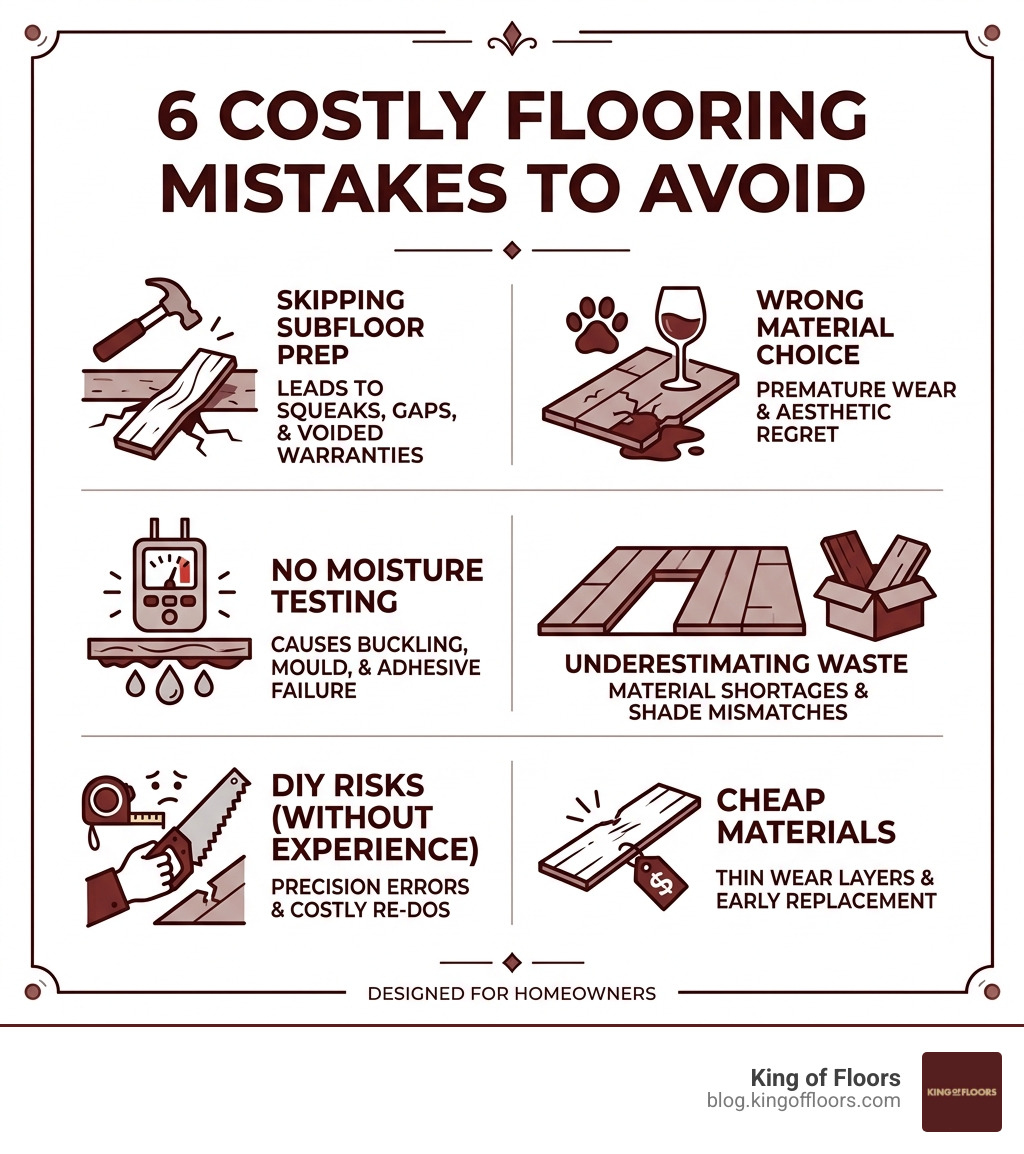
The most costly flooring mistakes to avoid include:
| Mistake | Why It Costs You |
|---|---|
| Skipping subfloor preparation | Leads to warping, squeaking, and voided warranties |
| Choosing the wrong material for your lifestyle | Premature wear, staining, and aesthetic regret |
| Ignoring moisture testing | Buckling, mould, and adhesive failure |
| Underestimating waste factors | Material shortages and visible shade lot mismatches |
| Falling for low-price advertising gimmicks | Hidden costs, thin wear layers, and early replacement |
| Attempting DIY without experience | Precision errors, damaged materials, and costly re-dos |
Flooring is one of the largest investments you will make in your home, and in BC’s climate especially, where humidity swings between wet winters and drier summers, even small oversights can snowball into thousands of dollars in repairs. The good news is that most of these mistakes are entirely preventable with the right information upfront.
I am Lesley Upton, Inventory Control Manager at King of Floors, and after more than a decade sourcing flooring from factories around the world and helping hundreds of BC homeowners navigate their choices, I have seen how costly flooring mistakes can be avoided simply by asking the right questions before installation begins. In the sections below, I will walk you through the patterns behind these mistakes and exactly how to sidestep them.
In our decades of experience serving the Lower Mainland, we have noticed that flooring failures are rarely random. They almost always follow a predictable pattern. Usually, it starts with a desire to save a few dollars upfront, which leads to a “shortcut” that compromises the structural integrity of the entire project.
When a floor fails, it isn’t just about the surface material. It is about the relationship between the material, the environment, and the foundation. If you ignore flooring replacement signs in your existing home or rush into a new build without checking the basics, you are essentially building on a shaky foundation. Common flooring pitfalls like warping, buckling, and persistent squeaking are symptoms of these underlying errors.
The pattern is simple: poor planning + ignored preparation = an expensive redo. By understanding these technical requirements, you can ensure your investment lasts for decades rather than just a few seasons.
Skipping Subfloor Preparation and Moisture Testing
If there is one rule we live by at King of Floors, it is this: your new floor is only as good as the subfloor beneath it. One of the most costly flooring mistakes we see is the assumption that a subfloor is “fine” just because it looks flat to the naked eye.
In reality, subfloors must be level to within 3/16” over a 10’ span. If your subfloor has high spots or “dips,” your new planks will flex every time you walk on them. Over time, this stress breaks the locking mechanisms, leading to laminate flooring mistakes like gapping or “telegraphing,” where the imperfections of the subfloor show through the surface.
Furthermore, moisture is the silent killer of floors in the Lower Mainland. Whether you are installing over a crawlspace in Langley or a concrete slab in a Vancouver high-rise, you must test for moisture. Concrete can hold moisture for months, even if it feels dry. Failing to use a proper vapour barrier or ignoring high moisture readings leads to adhesive failure and mould growth—problems that require a total tear-out to fix.
Choosing the Wrong Material for Your Lifestyle
We often see homeowners fall in love with a specific look in a showroom, only to realise it doesn’t fit their daily reality. Before committing, there are several things to know before buying engineered flooring or laminate.
For instance, a high-gloss, dark hardwood might look stunning in a magazine, but if you have a Golden Retriever in a sunny White Rock home, every scratch and speck of dust will be magnified. Similarly, putting a standard laminate in a “splash zone” like a laundry room or bathroom can lead to swelling at the seams.
| Feature | Laminate (AC5) | Engineered Wood |
|---|---|---|
| Scratch Resistance | Exceptional (High) | Moderate (Varies by species) |
| Moisture Tolerance | High (if water-resistant) | Moderate (Stable but sensitive) |
| Pet Friendliness | Best for claws | Good (can be refinished) |
| Best For | High-traffic, kids, pets | Living areas, bedrooms, resale |
Choosing a material with the wrong durability rating (such as an AC3 when you need an AC5) is a recipe for premature wear and aesthetic regret.
Underestimating Waste Factors and Measurements
“I measured the room, and it’s exactly 500 square feet, so I’ll buy 500 square feet of flooring.” This is a classic error. You must account for a waste factor—typically 10% for a straight lay and 15% for diagonal or complex patterns like herringbone.

Why? Because you lose material during cutting, and you need extra for door transitions and staircase trimming. One of the most frustrating costly flooring mistakes is running out of material mid-project. Flooring is produced in “batches” or shade lots. If you need to buy one more box a month later, it might come from a different production run, resulting in a visible colour mismatch.
When performing a Kronopol laminate evaluation, we always recommend keeping at least one full box of your original batch in storage for future repairs.
How to Avoid Costly Flooring Mistakes and Save Thousands
Avoiding a budget blowout requires a shift in perspective: view your floor as a long-term system, not just a surface. Proper project management involves getting itemised estimates and setting aside a 10-15% contingency fund for unexpected subfloor remediation once the old carpet or tile is pulled up.
One of the best ways to avoid common buying mistakes is to allow your materials to acclimate. In our humid BC climate, wood and laminate planks need to sit in the room where they will be installed for 48 to 72 hours (sometimes longer for solid wood). This allows the material to reach equilibrium with your home’s temperature and humidity, preventing it from shrinking or expanding and buckling after it is locked into place.
The Hidden Costs of DIY vs. Professional Installation
The “DIY discount” is often an illusion. While you might save on labour costs upfront, the hidden expenses can be staggering. You will need to rent specialised tools—saws, spacers, tapping blocks, and moisture meters. Then there is the “opportunity cost” of your time. A professional crew can often install a whole house in the time it takes an amateur to finish one bedroom.
There is also the matter of technical precision. For example, understanding the difference between AC4 and AC5 ratings is vital for choosing the right underlay and transition strips. Professionals also provide workmanship warranties. If a DIY floor buckles because you forgot the 1/4″ expansion gap at the wall, you have no recourse. If a pro makes that mistake, they fix it on their dime.
Why Cheap Materials Lead to Costly Flooring Mistakes
It is tempting to grab the cheapest “clearance” flooring from a big-box retailer, but these products often hide structural weaknesses. Cheap laminates frequently have thin wear layers that dull within a year and locking mechanisms that are prone to snapping.
Furthermore, some budget imports may have high VOC emissions or use inferior core materials that swell at the slightest hint of humidity.
At King of Floors, we focus on premium 10mm and 12mm options. For example, our Swiss-made 12mm AC5 laminate is engineered to withstand the rigours of a busy Canadian home. Investing in a higher-quality product actually saves you money by extending the replacement frequency from 5 years to 25 years.
Planning for Long-Term Value to Prevent Costly Flooring Mistakes
The best way to prevent costly flooring mistakes is to work with experts who understand the local landscape. King of Floors is a family-owned business that has been serving the Lower Mainland since 1984. We don’t just sell boxes; we provide the knowledge needed for a successful installation.
Our USP is simple: we offer the largest selection of high-quality European laminate flooring in stock. Because we import directly from Europe, we provide premium products at budget-friendly prices (all in CAD) without the middleman markup. Whether you are in Surrey, Fleetwood, or South Surrey, our showroom is designed to help you see, touch, and compare materials under realistic lighting.
If you are ready to start your project without the stress of hidden expenses, contact us to avoid expensive flooring errors. We can guide you through everything from subfloor prep to choosing the perfect transition strips.
Summary Checklist for Your Project:
- Test for moisture: Never skip this, especially on concrete.
- Level the subfloor: Use a straight edge; grind or fill as needed.
- Acclimate the material: Give your planks 3 days to get “comfortable.”
- Buy the waste: 10% extra is your insurance policy.
- Check the specs: Ensure your laminate is AC4 or AC5 for high-traffic areas.
- Hire a specialist: If the project involves complex cuts or stairs, a pro is worth every penny.
By following these steps and choosing quality over gimmicks, you can ensure your new floors add genuine value to your home for decades to come. Visit us at our Surrey warehouse to explore our “Today’s Specials” and find the perfect European-made floor for your lifestyle.