
Practical Basement Flooring Solutions for Lower Mainland Homes
Finding the right basement flooring solutions for a damp, busy household is one of the most common challenges we help Surrey homeowners work through.
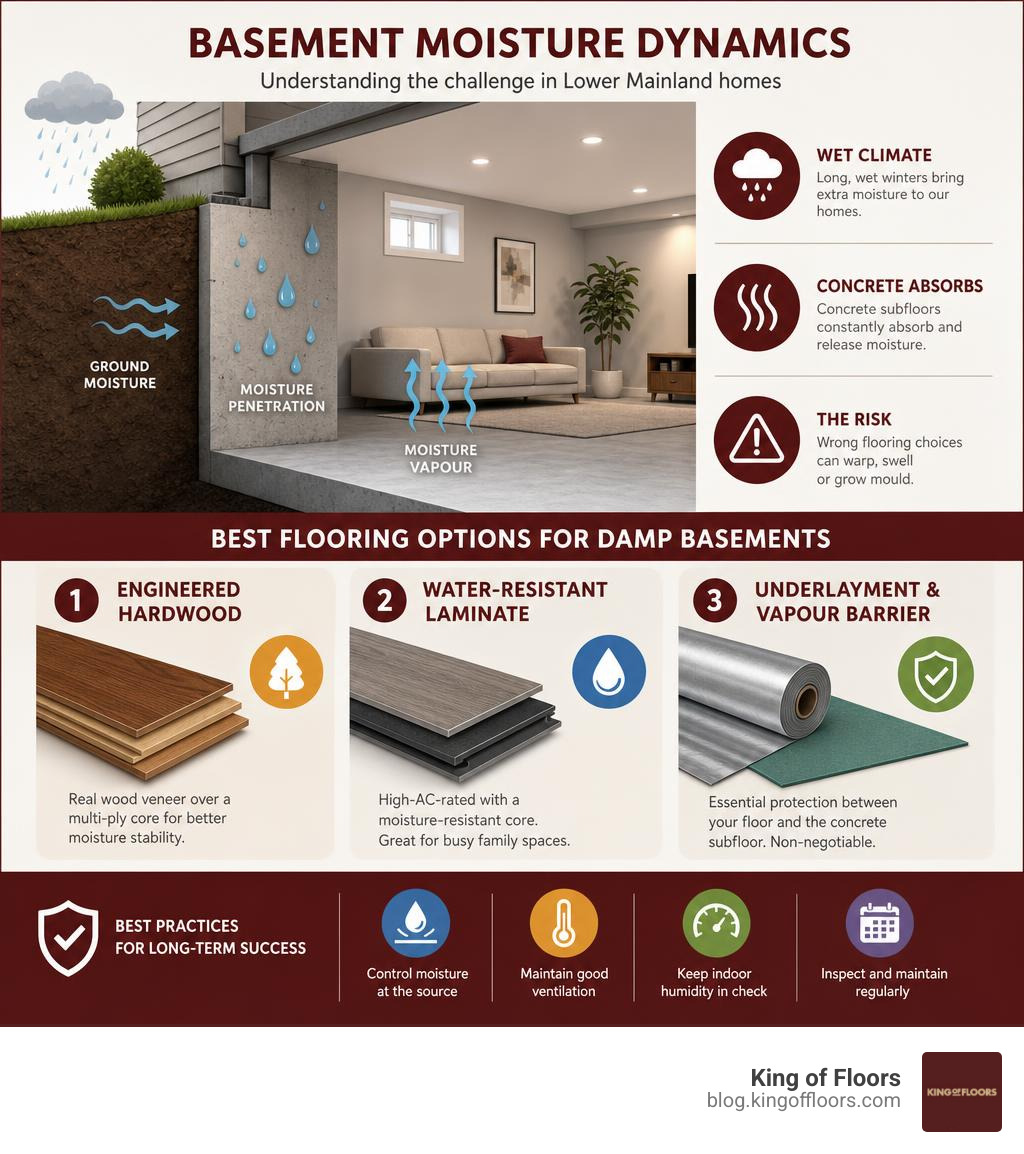
Basements in the Lower Mainland deal with something most above-grade rooms simply do not: concrete subfloors that constantly absorb and release moisture, especially through our long, wet winters. That means the flooring choices that look great upstairs can quietly warp, swell, or grow mould when installed below grade.
Here is a quick look at the most practical options for Lower Mainland basements:
- Engineered hardwood flooring: real wood veneer over a multi-ply core that handles moisture fluctuation far better than solid hardwood.
- Water-resistant laminate flooring: high-AC-rated European laminate with a moisture-resistant core, ideal for playrooms, family rooms, and home gyms.
- Proper underlayment and vapour barrier: not a flooring type, but non-negotiable in any basement installation.
Neither option is completely waterproof, and no floor is completely immune to scratches regardless of what the marketing says. What matters is choosing a product with the right moisture tolerance, wear rating, and subfloor preparation for your specific basement and lifestyle.
I’m Lesley Upton, Inventory Control Manager at King of Floors, and after more than 15 years helping BC homeowners navigate basement flooring solutions, I know how much the wrong choice can cost you in repairs and frustration. In the sections below, I’ll walk you through what actually works below grade in our climate, so you can make a confident, informed decision.
Evaluating Basement Flooring Solutions for Lower Mainland Homes
When you step down into a basement in Surrey, Langley, or White Rock, you are stepping below the water table of some of the wettest soil in Canada. Concrete is a porous material. It behaves like a dense sponge, pulling groundwater from the earth and releasing it into your home as invisible water vapour. This natural process is driven by hydrostatic pressure and relative humidity differences between the cold ground outside and your heated indoor air.
If you trap this moisture under an impermeable surface without proper preparation, it has nowhere to go. It pools, degrades adhesives, and creates a breeding ground for mould. Before we even talk about the beautiful boards you see on top, we have to look at what is happening underneath. Preparing your concrete slab is the single most important step in any basement renovation.

Why Traditional Solid Wood Fails as Basement Flooring Solutions
Many homeowners love the warmth of solid hardwood, but putting it directly over concrete in a Lower Mainland basement is a recipe for heartbreak. Solid wood boards are highly hygroscopic, meaning they expand and contract significantly as relative humidity changes.
When exposed to the constant humidity of a basement floor, solid wood suffers from cupping (where the edges of the board rise higher than the centre) and warping. Eventually, the boards will buckle and pull away from the subfloor entirely. Because solid wood lacks a stable, layered core to resist these physical forces, we strongly advise against using it in any below-grade installation.
Selecting the Right Underlayment for Basement Flooring Solutions
To protect your investment, you need a high-quality underlayment that acts as a vapour barrier. A vapour barrier is a specialized sheet of plastic or membrane placed directly over the concrete slab. This barrier stops moisture vapour from reaching your finished floor.
In cold BC winters, a quality underlayment also provides a thermal break. This small layer of insulation can make your basement floor feel up to 10 degrees warmer underfoot. For optimal results, we recommend a heavy-duty, closed-cell underlayment with joint-sealing tape to ensure a continuous moisture-proof seal across the entire floor.
What Scratch-Resistant Flooring Actually Means
If a flooring salesperson tells you their product is completely immune to scratches, it is time to find a new salesperson. In the real world, no wood-based or laminate floor is immune to damage. When we talk about scratch-resistant flooring, we mean a surface designed to withstand the typical friction of a busy household.

Scratch resistance refers to how well a floor resists everyday wear from pet claws, tracked-in grit, sliding chair legs, and heavy toys. Over time, every floor will show some signs of life. However, choosing a floor with a high-quality, textured wear layer helps disguise minor scuffs and keeps your basement looking newer for much longer.
AC Ratings Explained in Real-World Terms
If you are looking at laminate options, you will see a rating system called the AC (Abrasion Class) rating. This is an independent global standard that measures how much friction a laminate floor can handle before the decorative layer wears through.
- AC3: Designed for heavy residential use. This is perfect for normal family homes, bedrooms, and dining areas.
- AC4: Engineered for light commercial spaces. It offers excellent durability for active families with large dogs or high-traffic entryways.
- AC5: The highest rating available, built for heavy commercial use. While it is designed for busy shops and offices, it offers incredible durability and long-term cost-effectiveness in high-traffic residential basements.
Most premium European laminates manufactured in Switzerland, Germany, and Poland use advanced technology to achieve these high ratings. Brands like Kronoswiss, Kronopol, and Artureon are built to these exacting standards. Investing a bit more in an AC5 rated laminate means you are buying a floor that can handle years of playtime, fitness equipment, and heavy foot traffic without wearing thin.
What Causes Scratches in Laminate Floors
Even the toughest AC5 European laminate can be scratched if you do not protect it. The number one cause of scratches is not pet nails, but tiny particles of grit, sand, and dirt tracked in from outside. When these hard particles are stepped on, they act like sandpaper under pressure.
Other common culprits include heavy toys with sharp plastic edges and furniture legs that do not have protective pads. To keep your floors pristine, we recommend placing mats at all entryways, sweeping or vacuuming regularly to remove grit, and attaching heavy-duty felt pads to the bottom of all furniture legs.
Where Laminate Performs Well in Surrey Homes
High-quality laminate is incredibly versatile and works beautifully in many areas of a Lower Mainland home. In basements, it is a highly practical choice for playrooms because it is tough enough to handle dropped toys and spilled juice. It is also an excellent choice for home gyms, family media rooms, and even laundry areas, provided you clean up spills promptly.

For busy households in Surrey, Langley, and across Metro Vancouver, laminate offers a balanced combination of durability, style, and value.
Laminate vs Engineered Hardwood: A Lifestyle-Based Comparison
Choosing between laminate and engineered hardwood comes down to your budget, your aesthetic preferences, and how you plan to use the space.

Engineered hardwood features a real wood veneer (such as maple or oak) bonded to a stable, multi-ply substrate. This layered design prevents the wood from shifting during expansion and contraction cycles, making it the only real wood option suitable for basement installations. It gives you the unmatched warmth and prestige of genuine timber.
Laminate, on the other hand, uses a highly realistic printed photo layer topped with a tough resin wear layer. It is generally more budget-friendly than engineered hardwood and offers superior scratch resistance against pets and kids. If you want a luxurious, formal space, engineered hardwood is an excellent investment. If you need a tough, low-maintenance space for kids and pets, a high-quality European laminate is often the more practical choice.
- View engineered hardwood floors: engineered hardwood flooring
- Check out our popular options: engineered best sellers
Maintenance and Long-Term Wear: What to Expect
Keeping your basement floors looking beautiful for decades does not require hours of hard work, but it does require the right habits. For both laminate and engineered hardwood, you should avoid wet mopping. Sitting water can seep into the joints and cause the core of the boards to swell.
Instead, use a damp mop with a pH-neutral cleaner designed specifically for hard surfaces. When installing your floor, always ensure your installer leaves proper expansion gaps around the perimeter of the room and uses transition mouldings in doorways. This allows the floor to expand and contract naturally as the seasons change in the Lower Mainland.
FAQ About Laminate and Engineered Hardwood Flooring in Surrey
What does an AC rating actually mean for my basement floor?
An AC rating measures how well laminate resists wear. For a family basement, we recommend at least an AC3 or AC4 rating. If you have active pets or plan to build a home gym, upgrading to an AC5 rating provides excellent durability and long-term peace of mind.
Can engineered hardwood be sanded and refinished in a basement?
Yes, depending on the thickness of the real wood veneer. High-quality engineered hardwood with a wear layer of 3mm to 4mm can be professionally sanded and refinished once or twice. Always consult a professional to assess the thickness before starting any refinishing work.
Is laminate flooring suitable for a damp Lower Mainland basement?
Yes, provided you use a high-quality vapour barrier underlayment. Modern European laminates with water-resistant cores are highly stable and perform exceptionally well in humid basement environments, as long as the relative humidity in the room is kept within normal residential limits.
How do I protect my new floors from pet claws and heavy toys?
While high-quality flooring is scratch-resistant, you can protect high-traffic areas by placing area rugs or runners in play zones. Keep your pets’ nails trimmed regularly and put heavy-duty felt pads under all furniture legs to prevent deep scuffs when chairs or sofas are moved.
What is the difference between water-resistant and waterproof laminate?
Water-resistant laminate withstands surface spills for a limited time, usually 24 to 72 hours, before moisture penetrates the seams. Waterproof laminate features enhanced edge sealing and a denser core to prevent swelling, though it still requires a vapour barrier underneath to protect against concrete moisture.
Final Thoughts on Choosing Flooring in Surrey Homes
Selecting the right basement flooring solutions is all about balancing your personal style with the practical realities of the Lower Mainland climate.
At King of Floors, we believe in giving you honest, straightforward advice so you can choose a floor that fits your lifestyle, your budget, and your home’s unique needs. Whether you choose the timeless beauty of engineered hardwood or the rugged durability of a premium European laminate, we are here to help you every step of the way.
Your Next Steps
- Explore durable basement options on our laminate flooring page.
- Compare real wood looks on our engineered hardwood flooring page.
- Get local advice for your space by contacting our flooring team.