
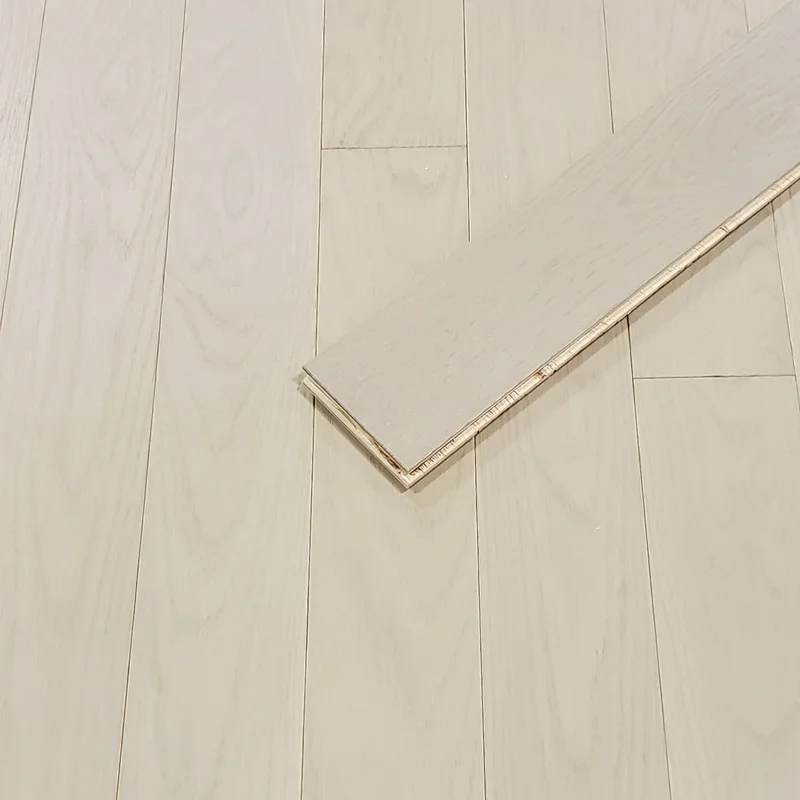
Why Engineered Wood Durability Matters Before You Buy
The durability of engineered hardwood flooring depends on wear layer thickness, core quality, installation, and maintenance. Here is what homeowners should know first:
| Factor | Engineered Hardwood |
|---|---|
| Typical lifespan | 20 to 40 years |
| Wear layer thickness | Usually 2mm to 4mm |
| Refinishing potential | Depends on veneer depth |
| Moisture resistance | Better than solid wood, not fully waterproof |
| Scratch resistance | Resistant to everyday wear, not damage-proof |
| Best for | Long-term living, resale value, natural aesthetics |
The durability of engineered wood is one of the first things homeowners ask about, and honestly, it is one of the most misunderstood. A lot of people assume that because it looks like solid hardwood, it performs exactly the same. Others assume the opposite, that it is a cheaper imitation that will not last. Neither is quite right.
Our climate throws a lot at your floors. We get humid, wet winters and drier summers, which means your flooring is constantly adjusting to shifting moisture levels. Engineered wood handles that better than solid hardwood thanks to its cross-layered core construction, but it is not invincible. No floor is. What it is, when you choose the right product and care for it properly, is genuinely tough, long-lasting, and worth the investment.
I’m Lesley Upton, Inventory Control Manager at King of Floors in Surrey. For over 15 years, I’ve helped BC and Vancouver homeowners who travel to our showroom for better options and pricing navigate these decisions, finding products that offer excellent real-world durability of engineered wood for our local climate.
What is Engineered Wood and How is it Constructed?
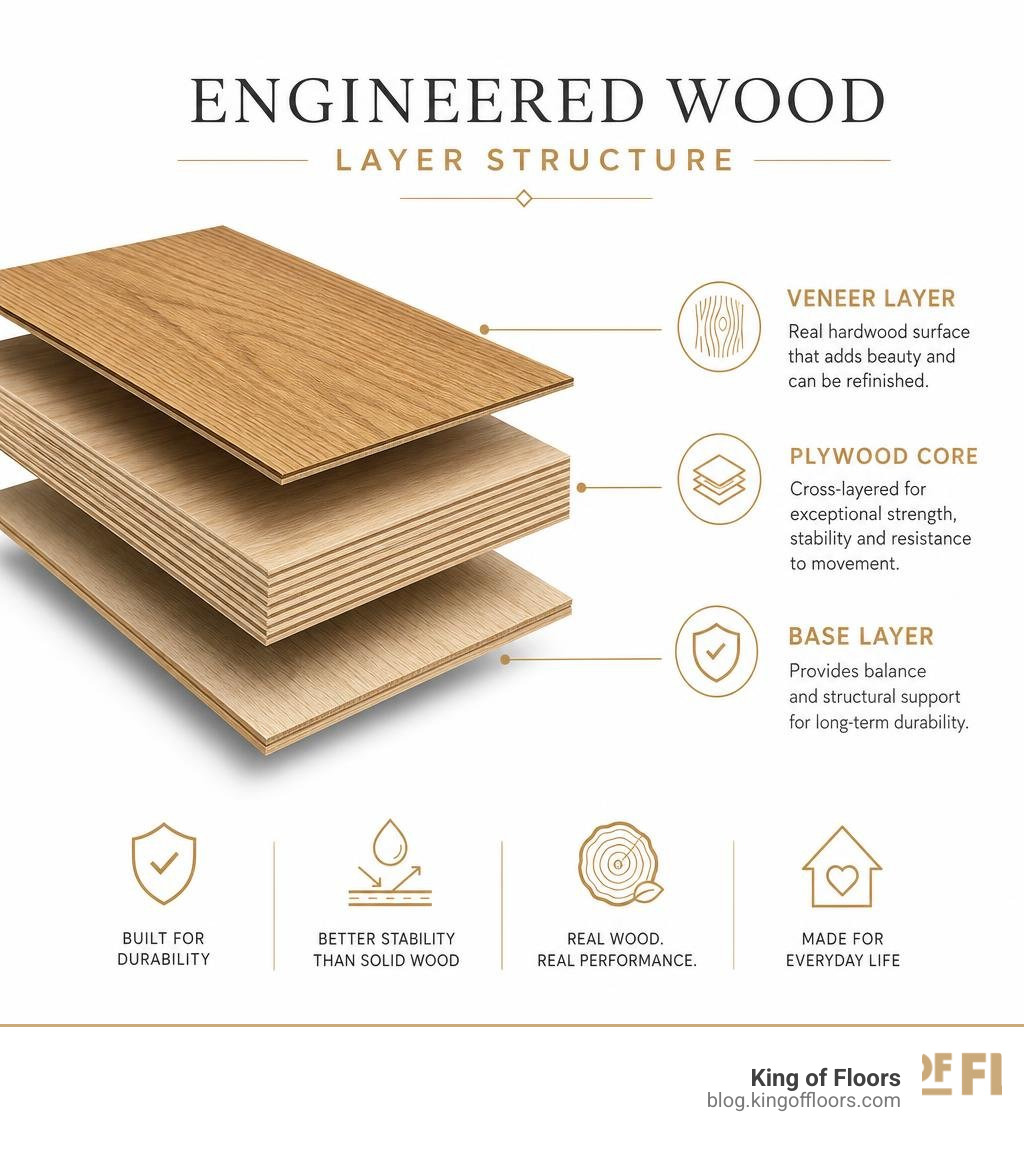
To understand how durable engineered wood really is, we have to look beneath the surface. Many people are surprised to learn that engineered wood is made of 100 percent real wood. It is not a synthetic imitation. Instead, it is a highly stable sandwich of natural timber layers bonded together under immense heat and pressure.
At the very top of each plank sits the real wood veneer. This is the face layer of genuine timber, such as oak, maple, or hickory, which gives the floor its unique grain pattern, warmth, and texture. This veneer is what you see and walk on every day. Below this beautiful surface layer lies the engine room of the floor: a stable, structural core. This core is typically made of multiple layers of plywood or high-density fibreboard (HDF) stacked and glued together.
What makes this construction so clever is the cross-grain stability. Each layer of the core is positioned with its grain running perpendicular, or at a 90-degree angle, to the layer above and below it. Because wood naturally expands and contracts along its grain when exposed to humidity changes, putting these layers in a cross-grain pattern means they pull against each other. This counter-balancing act locks the plank in place, providing incredible structural integrity.
When you choose high-quality engineered hardwood flooring, you are getting a floor designed to resist the warping, cupping, and twisting that can plague solid timber.
Core Materials and Dimensional Stability
When Vancouver and BC homeowners travel to our Surrey showroom for better options and pricing, they notice that different engineered hardwood floors use different core materials. The two most common are multi-ply backing and HDF cores.
Multi-ply backing typically consists of several thin layers of Baltic birch or marine-grade plywood. This style of core is highly regarded for its exceptional flexibility and strength. It offers fantastic expansion control, making it a brilliant choice for wider planks, which are naturally more prone to movement.
HDF cores, on the other hand, are made of highly compressed wood fibres mixed with resins. HDF is incredibly dense and offers excellent impact resistance, meaning it is less likely to dent if you drop something heavy.
Both core styles provide superior dimensional stability compared to solid wood. This stability is particularly important in BC homes where radiant heating systems are common. Solid wood flooring can easily dry out, crack, and gap when installed over radiant heat, but the engineered structure is designed to handle those gentle temperature fluctuations without breaking a sweat.
Engineered Wood Construction and Stability
The clever construction of engineered wood is not just great for stability, it is also a win for resource efficiency. Solid wood flooring requires thick planks cut entirely from slow-growing hardwood trees. With engineered wood, those precious, slow-growing hardwoods are reserved exclusively for the top veneer layer. The core layers are made from faster-growing, highly renewable species like birch, pine, or eucalyptus.
This resource-efficient approach means that a single hardwood log can produce up to four times as many engineered planks as it would solid wood planks. You get the exact same premium look and underfoot feel of solid timber while making a much more sustainable choice for your home.
Understanding the Durability of Engineered Wood
Now let’s tackle the big question: how long does it actually last?
Lifespan expectations for a quality engineered floor generally range from 20 to 40 years, depending on product construction, wear layer thickness, installation quality, and day-to-day care.
While this is slightly shorter than the 100-year potential of some solid hardwoods, the real-world performance in Surrey and Lower Mainland homes is highly comparable. Solid wood only lasts a century if it is sanded down and refinished every decade, a process that is messy, expensive, and rarely done more than twice by any single homeowner. Engineered wood is designed to handle the realities of modern, active households, managing everyday wear and tear beautifully without requiring constant, heavy-duty restoration.
How Wear Layer Thickness Impacts Durability
If there is one number you should pay close attention to when shopping for engineered hardwood, it is the veneer thickness, often called the wear layer. This is the top slice of real wood, and its thickness helps determine whether the floor can be lightly refreshed or professionally refinished over its lifetime.
- 2mm Wear Layer: Common in many engineered hardwood options. These floors are best suited for careful day-to-day maintenance and may be eligible for a light screen and recoat, depending on the product and finish, but they are not usually intended for repeated full sanding.
- 3mm Wear Layer: A strong residential choice for many homes. This thickness gives homeowners more flexibility for long-term care and may allow professional refinishing when there is enough usable veneer remaining.
- 4mm Wear Layer: Often considered a thicker residential wear layer. It offers better long-term repair potential than thinner options and can help extend the life of the floor when installed and maintained properly.
In most cases, hardwood wear layers are 2mm to 4mm. Choosing the right wear layer is about matching the floor to your household, budget, and long-term expectations rather than assuming thicker is always necessary.
Environmental Factors Affecting Engineered Wood
Even though engineered wood is highly stable, it is still a natural product that reacts to its environment. Wood performs best when your home’s relative humidity is kept between 35 and 55 percent, and the temperature stays between 18 and 24 degrees Celsius.
For Vancouver and BC homeowners who travel to our Surrey showroom, managing indoor humidity is key. Our wet, humid winters can cause indoor humidity to spike if a home is not well-ventilated. In contrast, running your heating system during dry spells can cause humidity levels to drop. If humidity levels swing too far outside the ideal range, engineered wood can experience minor cupping (where the edges of the plank rise higher than the center) or gapping (where small spaces appear between planks).
Fortunately, the cross-ply core of engineered wood limits this movement to a tiny fraction of what you would see with solid wood. Using a simple humidifier or dehumidifier to keep your home’s climate stable will keep your floors flat, tight, and beautiful for decades.
Key Factors That Determine Longevity and Performance
Beyond the core construction and wear layer, several key factors influence how well your floor will hold up against pets, kids, and heavy foot traffic. These include the wood species you choose, the type of protective finish applied at the factory, and how the floor is installed.

Wood Species and Janka Hardness
Not all wood species are created equal when it comes to dent resistance. The industry standard for measuring this is the Janka hardness rating, which measures the force required to embed a small steel ball halfway into a piece of wood.
For active households with busy hallways, big dogs, or young families, we highly recommend choosing species with higher Janka ratings. Oak engineered floors, particularly European and White Oak, sit in the mid-range with ratings around 1,360 lbf (pounds-force). They offer a fantastic balance of natural beauty, stability, and everyday strength.
If you need something even tougher, Maple engineered floors offer a Janka rating of around 1,450 lbf, while Hickory climbs even higher to 1,820 lbf. Choosing a harder species means your floor will resist the pressure of dropped toys, high heels, and pet paws much more effectively.
Protective Finishes and Scratch Resistance
Let’s be completely honest: no natural wood floor is entirely immune to scratches. While we often talk about scratch resistance, this refers to the floor’s ability to withstand everyday wear like dust, grit, and minor pet claws without showing unsightly marks. It is not a guarantee against deep gouges from dragging a heavy sofa across the room.
To protect the wood veneer, manufacturers apply advanced factory finishes. The most durable of these is aluminum oxide, which is one of the hardest mineral substances in the world. When suspended in a UV-cured polyurethane finish, aluminum oxide acts like a microscopic suit of armor, protecting the wood veneer from surface scratches and UV fading. Many premium prefinished floors feature up to 8 to 11 coats of this finish, ensuring your floor keeps its original lustre for years to come.
How Installation Impacts Lifespan
How your floor is put together matters just as much as what it is made of. There are three primary installation methods for engineered wood:
- Floating Installation: Planks are clicked or glued to each other but not attached to the subfloor. They float over a soft underlayment. This is highly DIY-friendly and allows the floor to expand and contract as a single unit.
- Glue-Down Method: Planks are bonded directly to the subfloor using high-strength adhesives. This is the recommended method for concrete slabs, as it creates an incredibly solid feel underfoot and eliminates any hollow sounds.
- Nail-Down Method: Planks are fastened to a wooden subfloor using cleats or staples. This is a traditional, highly secure method that offers excellent stability.
No matter which method you choose, the secret to a long-lasting floor lies in the prep work. The subfloor must be perfectly flat, clean, and dry. Installing a high-quality moisture barrier or vapour retarder underneath your floor is non-negotiable, especially for BC and Vancouver homeowners who travel to our Surrey showroom to find the right fit for their damp crawlspaces or concrete slabs.
Maintenance and Care to Maximize Lifespan
You do not need a degree in material science to keep your engineered wood floors looking incredible. In fact, the daily routine is remarkably simple. The key is consistency and avoiding a few common pitfalls that can damage the wood or its protective finish.
What to Avoid
Water is the natural enemy of any wood floor. While engineered wood is highly moisture-resistant compared to solid timber, it is not waterproof.
- Never use steam mops: The intense heat and pressurized moisture from a steam mop will force water deep into the wood layers, melting the adhesives holding the core together and causing rapid delamination and warping.
- Avoid wet mopping: Drenching your floor with a bucket of soapy water will allow moisture to seep into the seams between planks, leading to swollen edges.
- Skip harsh chemicals: Avoid ammonia, bleach, abrasive scouring powders, or wax-based polishes, which can dull or degrade the protective factory finish.
Long-Term Refinishing and Repairs
Over time, even the most carefully maintained floor will show some signs of life. If your floor has developed fine surface scratches but the wood underneath is still in great shape, you do not need a full, dusty sanding job. Instead, you can opt for a professional screen and recoat. This process involves lightly scuffing the existing topcoat and applying a fresh layer of protective polyurethane, instantly restoring the floor’s original shine.
If you do eventually need to sand the floor down to bare wood to fix deeper gouges, always consult a professional first. They will use specialized tools to measure your veneer’s remaining thickness, ensuring there is enough wood left to sand safely without exposing the plywood core beneath.
Engineered Wood vs Laminate Flooring
At King of Floors, we specialize in both engineered hardwood and premium European laminate. While both are fantastic options, they serve different needs, budgets, and lifestyles.
To help you decide, let’s look at how they stack up in plain English:
| Feature | Engineered Hardwood | Laminate Flooring |
|---|---|---|
| Material Type | Real wood veneer over layered wood core | Photographic wood design over dense HDF core |
| Lifespan | 20 to 40+ years | 15 to 25 years |
| Refinishing | Can be sanded and refinished (1 to 4 times) | Cannot be sanded or refinished |
| Scratch Resistance | Good (develops a natural patina over time) | Excellent (extremely tough wear layer) |
| Water Resistance | Moderate (requires prompt spill cleanup) | High (very water-resistant in modern formats) |
| Cost Range | Higher upfront investment, great long-term ROI | Budget-friendly, highly cost-effective |
When to Choose Engineered Hardwood
If you want the authentic warmth, unique grain patterns, and prestige of real timber, engineered hardwood is the clear winner. It is a long-term investment that adds genuine resale value to your home.
Vancouver and BC homeowners who travel to our Surrey showroom love the look of real wood, and knowing the floor can be refinished and customised in the future is a massive selling point. It is the perfect choice for living rooms, bedrooms, and dining spaces where you want to create a warm, inviting atmosphere that ages beautifully.
When to Choose Laminate
If you have an incredibly active household with large dogs, young kids, or high foot traffic, laminate flooring is a highly practical, stress-free alternative. Modern European laminates offer breathtakingly realistic wood textures that are almost indistinguishable from real timber.
Because laminate features an incredibly tough melamine wear layer, it offers superior scratch and dent resistance compared to real wood. It is also highly cost-effective, offering fantastic ROI for busy families who want a beautiful, low-maintenance floor that can handle the occasional spilled drink or muddy paw print without any stress.
Frequently Asked Questions
Can engineered wood floors be refinished?
Yes, but it depends entirely on the thickness of the real wood veneer. In most cases, hardwood wear layers are 2mm to 4mm. Thicker wear layers generally give more room for professional refinishing, while thinner options may be better suited to screening and recoating.
Is engineered wood flooring waterproof?
No, engineered wood is highly moisture-resistant, but it is not waterproof. While its cross-ply core prevents warping, standing water left on the surface can still seep into the seams, causing swelling, mould, or delamination. Always wipe up spills within five to ten minutes.
How long does engineered wood flooring last compared to laminate?
Engineered hardwood typically lasts 20 to 40 years because it can often be refreshed or refinished depending on wear layer thickness. Laminate floors generally last 15 to 25 years. While laminate is highly scratch-resistant, once the surface eventually wears through, the entire floor must be replaced.
Can engineered wood be installed over concrete subfloors?
Yes, absolutely. Thanks to its dimensional stability, engineered wood is ideal for concrete subfloors, including basements. You can install it using either the glue-down method or by floating it over a high-quality underlayment with a built-in vapour barrier to block moisture from the concrete.
What is the best humidity level for engineered wood?
The ideal relative humidity for engineered wood is between 35 and 55 percent. Keeping your home within this range prevents the wood from drying out and gapping during dry spells, or absorbing excess moisture and cupping during damp BC winters.
Is Engineered Wood the Right Durable Choice for Your Home?
Choosing the right flooring is a major decision, and understanding the durability of engineered wood is key to making the right choice for your lifestyle and budget in 2026. If you love the unparalleled character of real timber and want a long-term investment that can be refinished to last for decades, premium engineered hardwood is a beautiful, durable choice that handles our local climate with ease.
At King of Floors in Surrey, we serve broader BC and Vancouver homeowners who travel to our showroom for better options and pricing. We believe in giving honest, practical advice to help you find the perfect match for your home.
Whether you are looking for the natural elegance of engineered oak or the tough, family-friendly performance of a premium European laminate, we are here to help.
Ready to see these beautiful textures and structures in person? Contact our flooring experts today or visit our Surrey showroom to find the perfect floor for your home.