
Comparing Structural and Non-Structural engineered wood types
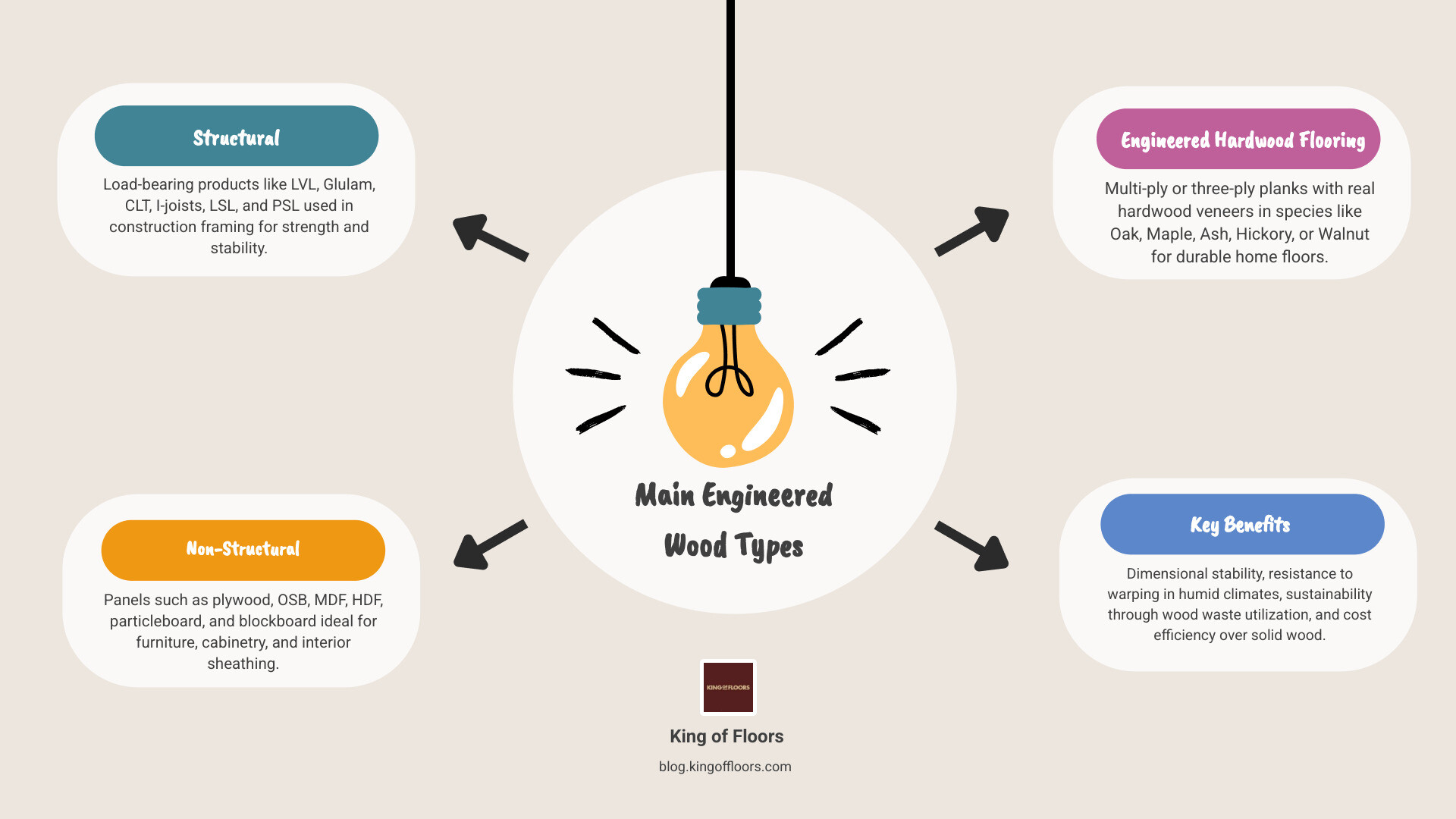
Engineered wood types cover a surprisingly broad range of products, from the structural beams holding up a BC home’s frame to the beautiful hardwood floors underfoot. Here is a quick overview of the main categories:
- Structural engineered wood: LVL (Laminated Veneer Lumber), Glulam, CLT (Cross-Laminated Timber), I-joists, LSL (Laminated Strand Lumber), PSL (Parallel Strand Lumber)
- Non-structural engineered wood: Plywood, OSB (Oriented Strand Board), MDF (Medium-Density Fibreboard), HDF (High-Density Fibreboard), Particleboard, Blockboard
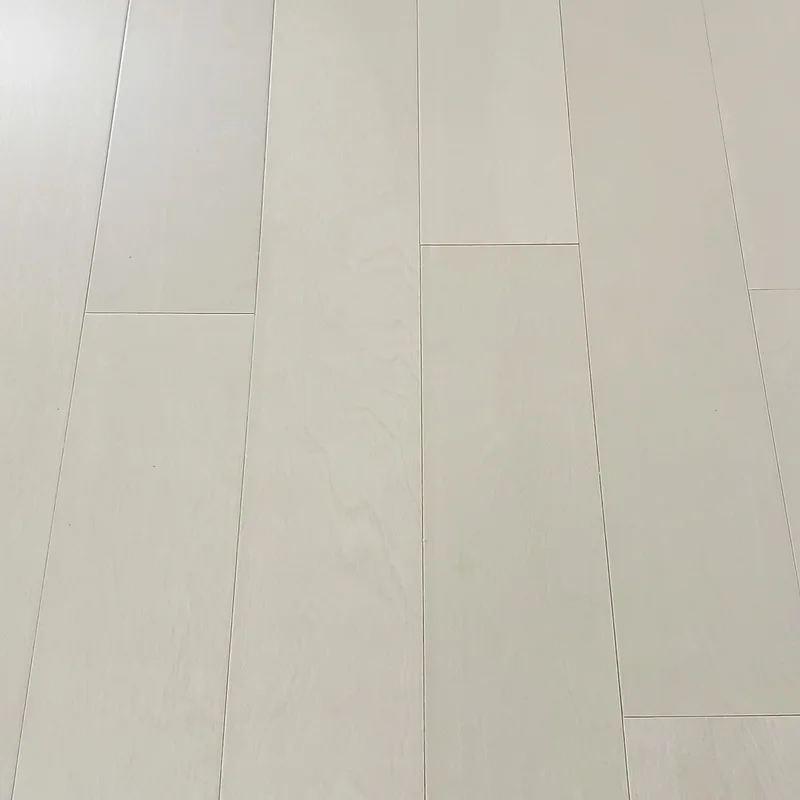
- Engineered hardwood flooring: Multi-ply and three-ply constructions with a real hardwood veneer in species like Oak, Maple, and Ash, Hickory, or Walnut
If you live in Surrey or anywhere across the Lower Mainland, you already know that choosing the right flooring is not as simple as picking a colour you like. Between BC’s coastal humidity, busy family households, and the very real chaos of muddy paws charging through the door after a rainy walk, your floors need to work hard. We have seen this time and time again in Surrey homes: the wrong flooring choice leads to warping, swelling, or a finish that gives up long before you do.
That is where understanding the different engineered wood types really pays off. Whether you are renovating a townhouse in Fleetwood, finishing a basement suite in White Rock, or building new in Langley, the right engineered wood product can save you money, stress, and a future floor replacement. Not all engineered wood is created equal, and knowing the difference between a structural I-joist and an engineered hardwood plank matters more than most people realise before they start a project.
I’m Lesley Upton, Inventory Control Manager at King of Floors, and with over 15 years of sourcing engineered wood types from factories around the world, I’ve helped hundreds of Surrey and Lower Mainland homeowners find flooring that genuinely fits their lives. I’ll walk you through everything you need to know so you can make a confident, informed choice.
When we talk about engineered wood types, we’re basically talking about smarter, reworked versions of real wood. It’s still the real deal, just built a bit differently. Think layers of wood (veneers, fibres, or strands) pressed and bonded together to make something stronger and more stable.
Why go through all that effort? Simple. Solid timber can be a bit unpredictable. It expands, contracts, and sometimes throws in knots or uneven grain just to keep things interesting.
Engineered wood smooths all that out, giving you a more consistent, reliable option, especially handy in BC where the weather can do its thing. If you want to see how this actually plays out in real homes, check out our engineered hardwood ultimate guide.
Structural engineered wood types for BC Construction
Structural engineered wood is the backbone of modern building in the Lower Mainland. These products are designed to carry heavy loads and span distances that solid wood simply cannot handle without sagging or breaking.
One of the most common sights on a Surrey construction site is the I-joist. As of 2004, approximately 81% of all wood light-framed floors used I-joists. They are incredibly efficient because they use a vertical “web” (often OSB) between two horizontal flanges, providing superior resistance to bending.
Other heavy-hitters include:
- LVL (Laminated Veneer Lumber): These are made by stacking thin veneers with the grain all running in the same direction. This makes them perfect for headers over windows and doors where you need maximum vertical strength.
- Glulam (Glue Laminated Timber): These are layers of dimensional lumber bonded together. Because they can be manufactured in curved shapes, they are often used for architectural statements in BC homes.
- CLT (Cross-Laminated Timber): This is the future of mass timber. By layering boards perpendicularly, builders create massive panels that can replace concrete and steel. In fact, mass timber buildings can save 20-25% in construction time and around 20% in embodied carbon.
- LSL (Laminated Strand Lumber): Composed of about 95% wood fibre and 5% resin, LSL is incredibly dense. While it costs about 3 times more than dimensional lumber, its strength is unmatched for rim boards and tall wall studs.
Non-Structural engineered wood types for Modern Interiors
Now, let’s talk about what you actually see and touch inside your home. Non-structural engineered wood types are focused on stability, aesthetics, and smooth finishes for cabinetry and flooring.
- Plywood: The classic choice. Its cross-grain construction means it won’t split easily and stays very flat.
- MDF (Medium-Density Fibreboard): Made from wood fibres, it has no grain. This makes it the go-to for painted trim and cabinet doors in Surrey renovations.
- HDF (High-Density Fibreboard): Much denser than MDF, HDF is the core material we use for our premium engineered flooring. It provides the impact resistance needed for a “small circus” household.
- Engineered Hardwood: This is the star of the show. It features a real hardwood veneer (like Oak or Maple) over a stable core.
| Feature | Structural (e.g., LVL, CLT) | Non-Structural (e.g., MDF, Plywood) |
|---|---|---|
| Primary Use | Framing, Beams, Load-bearing | Flooring, Cabinets, Furniture |
| Stability | High load capacity | High dimensional stability |
| Cost (CAD) | Higher (Investment in frame) | Varies (Focus on ROI) |
| Moisture Resistance | Moderate (Requires protection) | Varies (HDF is superior for floors) |

Find the Right Flooring for Your Surrey Home with King of Floors
At King of Floors Surrey, we’ve been a family-owned staple since 1984. We remember when everyone wanted solid oak, and we’ve watched the industry shift toward engineered wood types because they simply perform better in our unique BC climate.
Our late mascot, Sir Scruffy, used to test the durability of our showroom floors with his own “muddy paw” sprints. We learned early on that beyond solid understanding engineered wood flooring is the key to a happy home in the Lower Mainland.
What is engineered wood and how is it made?
Engineered wood is a composite material that cleverly uses wood resources. It is made by taking wood strands, veneers, or fibres and bonding them with adhesives under heat and pressure.
The secret to its success in BC is “cross-grain lamination.” By stacking layers with the grain running in opposite directions, each layer offsets the natural tendency of the other to expand or contract. This results in incredible dimensional stability, which is vital when the humidity in Surrey jumps from a dry winter morning to a soggy spring afternoon.
What are the primary advantages of engineered wood over solid natural wood?
If you are weighing the engineered hardwood cost, the upfront price is only half the story. The long-term ROI of engineered wood often beats solid wood for several reasons:
- Sustainability: It uses fast-growing trees and waste wood, making it more resource-efficient.
- Stability: It is far less likely to warp, cup, or gap than solid planks.
- Width Options: Because it is so stable, we can offer much wider planks (up to 7 or 9 inches) that wouldn’t be possible in solid wood without massive stability issues.
- Uniformity: You get a more consistent look across your entire floor.
How does engineered wood perform in terms of moisture and fire resistance?
In the Lower Mainland, moisture is our biggest enemy. Engineered wood, particularly those with an HDF core or high-quality plywood substrate, handles humidity far better than solid wood.
In terms of fire resistance, mass timber products like CLT actually perform surprisingly well. When exposed to fire, the outer layer chars, creating a protective “char layer” that insulates the inner core and maintains structural integrity. For flooring, the density of the core helps slow the spread of heat.
What should consumers consider when selecting engineered wood for flooring projects?
When you visit our Surrey showroom, we want you to look past just the colour. Consider these factors:
- Wear Layer Thickness: This is the real hardwood on top. A thicker layer (3.5mm to 6mm) allows for future refinishing.
- Janka Hardness: This measures how well the wood resists dents. Hickory and Oak are great for high-traffic areas.
- Surface Finish: A brushed or distressed finish is a lifesaver for hiding those “Sir Scruffy” scratches, whereas a smooth finish offers a modern, sleek look.
- Installation Method: Many of our top rated engineered hardwood options feature click-lock systems that are perfect for a DIY weekend.
Are engineered wood products environmentally friendly?
Yes! Using mass timber and engineered flooring is an excellent way to sequester carbon. Laminated wood sequesters around 582 kg of CO2 per cubic metre. Compare that to reinforced concrete, which emits 458 kg of CO2 during production, and the environmental choice becomes clear.
By using waste wood and fast-growing species for the core layers, we ensure that less of our precious old-growth forests are needed for every square foot of flooring.
Can engineered hardwood be refinished like solid wood?
This is a common question in our Surrey showroom. The answer depends on the veneer thickness. If you choose a high-quality floor with a wear layer of at least 3mm, you can typically sand and refinish it 1 to 3 times.
With a 6mm wear layer, you get a lifespan of 25 to 75 years, rivaling solid hardwood while maintaining the stability of an engineered product. For homes with kids and pets, we often recommend distressed engineered hardwood because the texture already masks minor wear, extending the time between refinishes.
King of Floors Surrey Flooring FAQs (Lower Mainland & BC Guide)
Which wood species is best for a home in Surrey?
For the Lower Mainland, Oak and Maple are excellent choices. Oak has a strong grain that hides scratches well, while Maple offers a cleaner, more contemporary look. If you have a very active house, Hickory is one of the hardest options available.
Is engineered hardwood better than laminate for BC humidity?
Both are excellent choices. Our European laminate is incredibly moisture-resistant and stable. Engineered hardwood offers the prestige and feel of real wood with better stability than solid planks. Your choice should depend on your budget and whether you want the option to refinish the floors in 20 years.
Can I install engineered flooring over radiant heat?
Yes, engineered wood is the preferred choice for radiant heat systems. Its layered construction allows it to handle the temperature fluctuations better than solid wood, which would likely warp or crack under the same conditions.
How do I clean my engineered wood floors?
Avoid steam mops! Use a pH-neutral wood cleaner and a microfiber mop. In our rainy BC climate, the best thing you can do is have a good mat at every entrance to catch grit and moisture before it hits your beautiful new floors.
Does King of Floors offer delivery in the Lower Mainland?
Absolutely. We serve Surrey, Langley, White Rock, and the entire Metro Vancouver area. Because we stock so much of our flooring right here in Surrey, you aren’t waiting weeks for a shipment to arrive from across the border.
Find the Right Flooring for Your Surrey Home with King of Floors
Choosing between the various engineered wood types doesn’t have to be overwhelming. At King of Floors, we focus on providing the best value for BC homeowners by sourcing directly from factories. This means you get premium European-quality flooring without the middleman markup.
Whether you are looking for the timeless elegance of Oak, the durability of Maple, or the unique character of Hickory and Walnut, we have the stock ready to go. Our expertise in BC’s coastal humidity ensures that every floor we sell is built to last in our local environment.
Get started today:
- Explore: Browse our massive selection of engineered wood flooring online.
- Save More: Check out our discount engineered wood flooring guide for the best deals.
- Visit Us: Come see the difference for yourself at our Surrey showroom. We’ll help you find the perfect foundation for your home, muddy paws and all.