
Are the Pros Cons Engineered Hardwood Worth It for Your Home?
The pros cons engineered hardwood debate comes up constantly among homeowners who want the warmth and beauty of real wood without the headaches that can come with solid hardwood. Here is a quick breakdown to answer that question right away:
Pros of Engineered Hardwood:
- Real wood look and feel at a lower price point than solid hardwood
- Superior dimensional stability in humid or variable climates
- Can be installed over concrete, in basements, kitchens, and other moisture-prone areas
- Multiple installation methods, including DIY-friendly click-lock floating floors
- More sustainable use of hardwood resources
- Wide range of species, widths, and finishes available
Cons of Engineered Hardwood:
- Thinner wear layers limit how many times the floor can be refinished
- Not fully waterproof; standing water can still cause damage
- Quality varies significantly between manufacturers
- Can fade with prolonged UV exposure
- Some lower-quality products may off-gas VOCs from adhesives
Engineered hardwood now accounts for roughly 30% of all wood flooring sold in North America, and for good reason. It delivers the authentic grain patterns and warmth that homeowners love about solid hardwood, while offering practical advantages that make it a genuinely smart fit for modern family homes, especially here in Metro Vancouver where our damp coastal climate can be tough on traditional wood floors.
This guide walks through 10 compelling reasons why engineered hardwood deserves serious consideration for your next renovation, along with an honest look at where it falls short, so you can make a confident, informed decision.
I’m Lesley Upton, Inventory Control Manager at King of Floors, and after more than a decade of sourcing flooring from factories around the world and helping customers weigh up the pros cons engineered hardwood for their specific spaces and budgets, I have seen what works and what to watch out for. Let’s dig in.
1. Superior Dimensional Stability and Real Wood Aesthetics
When you walk into our Surrey showroom, the first thing you notice about our premium engineered flooring is that it looks exactly like solid wood. That is because the top layer, the part you actually see and walk on, is a genuine hardwood veneer. If you love the classic grain of White Oak or the deep, rich tones of Walnut, you are getting the real thing.
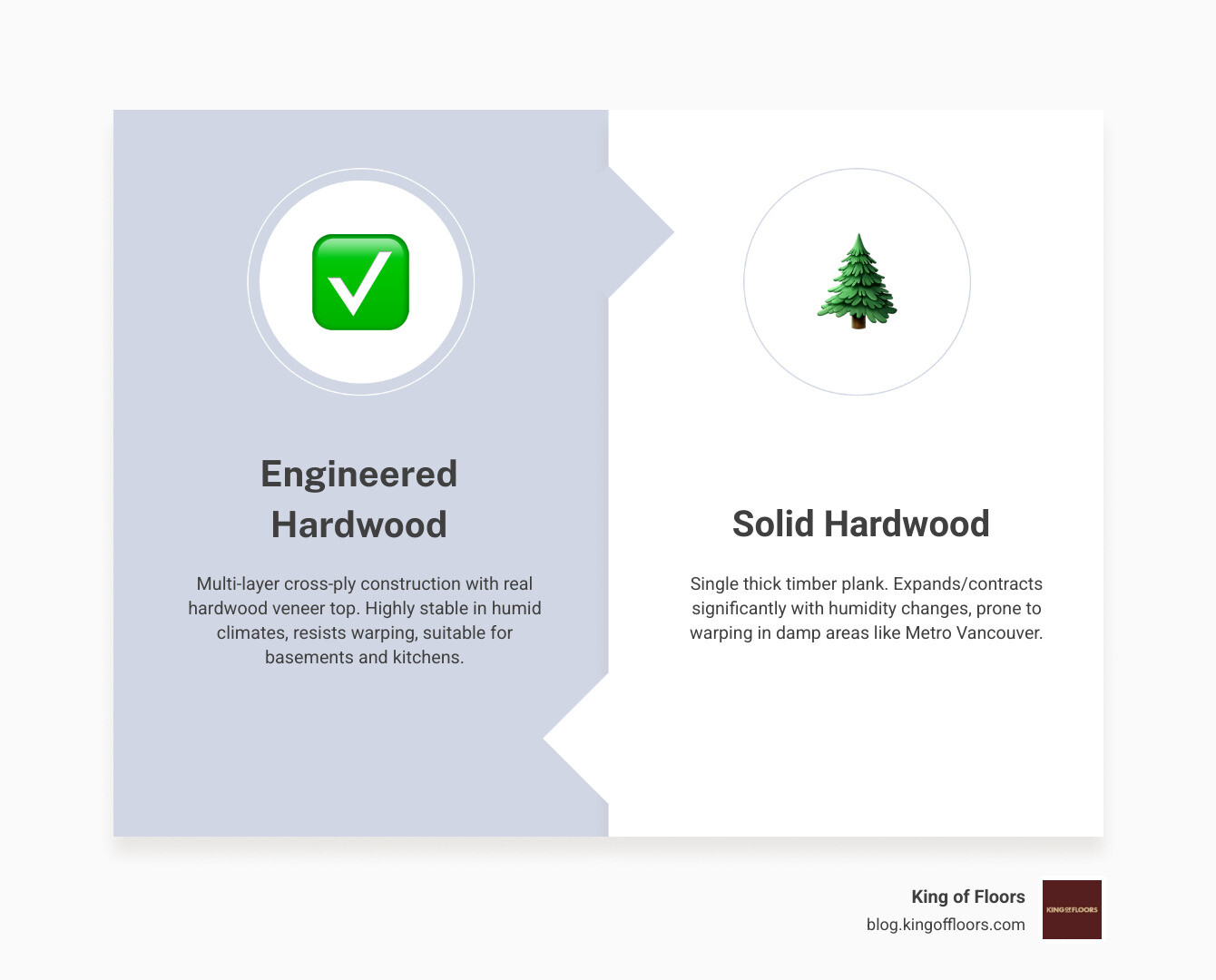
However, the “magic” of engineered hardwood is what lies beneath that veneer. While solid hardwood is one thick piece of timber that expands and contracts significantly with changes in humidity, engineered planks are built using a cross-ply construction. This means layers of wood (usually plywood or high-density fiberboard) are glued together at 90-degree angles.
This structure provides incredible dimensional stability. In a place like Surrey, where we experience damp winters and dry summers, solid wood planks wider than five inches often risk “cupping” or shifting. Because of its core, engineered hardwood can be manufactured in trendy wide-plank formats, up to 10 or 12 inches wide, without those same risks. Recent reports indicate that natural materials are a leading home design trend for 2024, and these wide planks are the perfect way to capture that timeless look while keeping your floor flat and beautiful.

2. Moisture Resistance for Kitchens and Basements
One of the biggest “cons” of traditional solid wood is its sensitivity to moisture. You would never dream of putting solid oak in a basement or a high-traffic kitchen where spills are a daily occurrence. Engineered hardwood changes the game.
Because the layers are pressed together so tightly, the planks are much more resistant to the warping effects of humidity. This makes it a viable option for “below-grade” installations (basements) or over concrete subfloors common in many Metro Vancouver homes. We often get asked, can you use engineered wood flooring in a bathroom? While we generally recommend luxury vinyl for full bathrooms with showers, engineered hardwood is a fantastic, stable choice for powder rooms and kitchens.
Balancing the Pros Cons Engineered Hardwood for High-Humidity Areas
It is important to understand the distinction between “water-resistant” and “waterproof.” Most engineered floors are water-resistant, meaning they can handle a spilled glass of water or wet boots if you wipe them up quickly. Some advanced products, like those featuring a 36-hour moisture protection system, offer even more peace of mind.
To keep your floors in top shape during our rainy BC seasons, we suggest maintaining a consistent indoor humidity level and using expansion gaps during installation. For a deeper dive into how these floors handle the elements, check out our engineered hardwood ultimate guide.
3. Evaluating the Pros Cons Engineered Hardwood for Your Budget
Let’s talk about the bottom line. When comparing the pros cons engineered hardwood, cost is often a major “pro.” Generally, engineered hardwood is more budget-friendly than solid hardwood, both in terms of the material itself and the installation labour.
In the Canadian market, you can find quality engineered options ranging from approximately $4.50 to $16.00 per square foot (CAD). In contrast, solid hardwood can climb as high as $28.00 per square foot for exotic species. Because engineered planks use less of the expensive “show wood” and more of the sustainable core wood, you get the luxury look for less.
| Flooring Type | Average Cost (CAD/sq. ft.) | Typical Lifespan | Best For |
|---|---|---|---|
| Engineered Hardwood | \~$4 – $16 (materials) + install | \~20 – 40 years (premium higher) | Basements, kitchens, living areas (more moisture stable) |
| Solid Hardwood | \~$5 – $28+ (materials) + install | \~30 – 100+ years | Main floors, dry climates (classic hardwood) |
| Premium Laminate | \~$3 – $7 (materials) | \~15 – 25 years | High‑traffic areas, budget options |
Note: Further discounts may be available; please call our Surrey warehouse for details.
Investing in engineered wood is also a smart move for your home’s resale value. Unlike laminate or carpet, engineered wood is viewed as a “real wood” floor by appraisers and buyers, often adding thousands of dollars to a home’s value during a Surrey renovation. For a full breakdown of pricing, see our engineered hardwood cost complete guide.
4. DIY-Friendly Installation and Sustainability
If you are a weekend warrior looking to save on labour costs, engineered hardwood is your best friend. Unlike solid wood, which must be nailed or stapled down to a plywood subfloor, many engineered products feature a click-lock system. This allows for a “floating floor” installation: no glue, no nails, and no mess.
This versatility means you can install it over existing tile, vinyl, or concrete, provided the surface is level. If you prefer a more permanent feel, you can still glue or nail it down.
From a sustainability standpoint, engineered wood is a winner. It uses about one-third of the amount of slow-growing hardwood species compared to solid planks. We take health seriously, too. To avoid this possibility by choosing reputable manufacturers, we stock products that meet strict low-VOC (Volatile Organic Compound) standards, ensuring your indoor air quality stays fresh.
Understanding the Pros Cons Engineered Hardwood Wear Layers
The “wear layer” is the most critical spec to check. This is the thickness of the real wood on top.
- 1mm – 2mm: Budget-friendly, can usually be “refreshed” but not fully sanded and refinished. Expected life: 20-30 years.
- 3mm – 4mm: The “sweet spot” for quality. Can be professionally refinished 1-3 times. Expected life: 40-50+ years.
- 6mm: Premium thickness that rivals solid wood for longevity.
Before you buy, read these key things to know before buying engineered flooring so you choose a wear layer that fits your lifestyle.
5. Long-Term Durability and Maintenance Tips
We know that life in Surrey can be messy. Between rainy-day paw prints and kids playing with toys, your floors need to be tough. Engineered hardwood is designed for durability. Many of our products feature UV-cured factory finishes with aluminum oxide, which is significantly harder and more scratch-resistant than a finish applied on-site.
Real life wear and tear is the ultimate stress test for engineered hardwood. The good news is that keeping these floors looking sharp is mostly about a few simple habits:
- Sweep or vacuum daily: Removing grit helps prevent micro-scratches and dulling.
- Use area rugs: Add them in high-traffic zones and near strong sunlight to reduce wear and fading.
- Add furniture pads: Put felt protectors on chair and table legs to prevent scuffs.
- Avoid steam mops: Extra heat and moisture can damage the finish and, in some cases, weaken the bond between layers.
For a balanced look at the long-term trade-offs, read our guide to the pros and cons of engineered hardwood.
FAQs
Can engineered hardwood be refinished to extend its life?
Yes, but it mostly comes down to how thick the wear layer is. If your engineered planks have a 3 mm to 4 mm hardwood veneer, a professional can usually sand and refinish them once or twice over their lifetime. If the wear layer is thinner (around 1 mm to 2 mm), full sanding is typically not recommended. In that case, you are usually limited to a screen-and-recoat, which refreshes the protective finish without removing wood. For a deeper breakdown, read a-comprehensive-guide-to-top-engineered-wood-flooring.
Is engineered hardwood suitable for radiant heating systems?
Absolutely! In fact, it is often preferred over solid hardwood for radiant heat. Because of its multi-layer core, it handles the temperature fluctuations of underfloor heating much better than solid wood, which is prone to drying out and gapping. It is a very popular choice for keeping Surrey homes cozy in the winter.
How long does engineered hardwood flooring typically last?
With proper care, a high-quality engineered floor will last between 20 and 50 years. The primary factor is the wear layer thickness and the Janka hardness rating of the wood species you choose. For example, Hickory or Maple will resist dents better than a softer wood like Pine.
Conclusion
At King of Floors, we believe that choosing the right flooring shouldn’t be a stressful chore. As a family-owned business in Surrey since 1984, we have built our reputation on being honest, approachable, and maybe a little bit obsessed with finding the best deals for our neighbours. Our massive 85,000 sq. ft. warehouse is packed with options that balance the pros cons engineered hardwood perfectly for your specific needs.
If you are looking for the latest European design trends or a durable floor that can handle a busy family, we are here to help with expert advice and a “smart casual” attitude. Ready to see the difference for yourself? Explore our Engineered Hardwood Collections or come visit us in Surrey today!